
Twiggy Documentary 2026: The 1960s Fashion Icon Returns to the Spotlight With “The Woman Behind the Icon
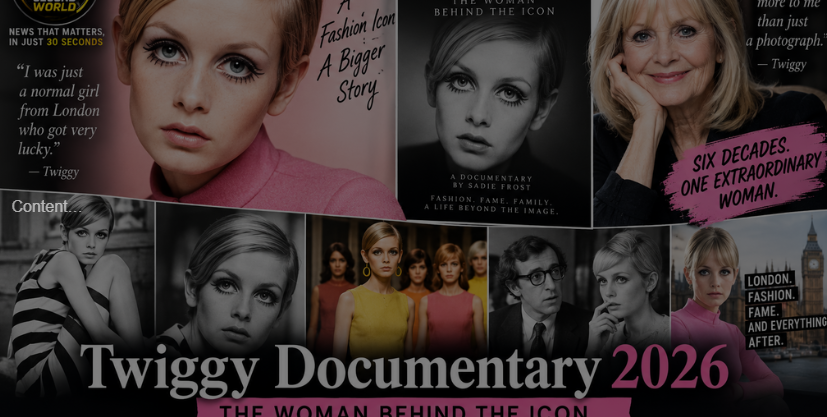
Twiggy Documentary 2026: The 1960s Fashion Icon Returns to the Spotlight With “The Woman Behind the Icon”
Twiggy, one of the most recognizable faces in fashion history, is back in the spotlight as a new documentary revisits the extraordinary life and career of the British model who helped define the look of the 1960s.

The documentary, “Twiggy: The Woman Behind the Icon,” directed by Sadie Frost, is arriving in the United States this month after first being released in 2025. The film looks beyond Twiggy’s famous image and explores the person behind the hairstyle, eyelashes and fashion phenomenon that made her an international star as a teenager.
Now nearing 77, Twiggy — born Lesley Hornby — has spent roughly six decades working across modeling, acting, theater, singing and fashion design.
And that may be the most important theme of the documentary:
Twiggy’s story did not end when the 1960s did.
Who Is Twiggy?
Twiggy was born Lesley Hornby in London and became famous at just 16 years old.
Her appearance was dramatically different from the dominant modeling aesthetic of the time.
She was known for:
- short blond hair
- large blue eyes
- dramatic eyelashes
- freckles
- a petite frame
- a youthful, modern look
In 1966, a fashion editor came across photographs of the teenage Hornby, and her career quickly exploded.
Her new nickname — Twiggy — became internationally famous.
Within a remarkably short period, she went from an ordinary working-class London teenager to one of the best-known models in the world.
Why Twiggy Changed Fashion
Twiggy arrived at a moment when London itself was changing.
The 1960s brought:
- new music
- youth culture
- Mod fashion
- shifting class boundaries
- changing attitudes toward women
- and a much younger visual identity in advertising and magazines
Twiggy became closely associated with that transformation.
She did not resemble the more mature, aristocratic image that had previously dominated fashion.
Instead, she represented a new generation.
Her look became closely tied to what was often called the “Youthquake” era.
The New York Times profile described how her appearance captured the energy and new possibilities of London’s changing culture.
From Working-Class London to Global Fame
Twiggy’s background also made her unusual.
Her father was a carpenter, and she came from a working-class family.
At the time, high-fashion modeling was not an obvious career path for girls from backgrounds like hers.
Twiggy herself has reflected on how unusual it was for someone from her family and neighborhood to enter that world.
Her rapid rise therefore became about more than fashion.
It also represented a shift in who could become famous.
She Was Only a Model for a Few Years
One of the most surprising facts about Twiggy’s career is that her original modeling period was relatively short.
She modeled professionally for only about four years before moving into other areas of entertainment.
During that time, however, she worked with major photographers including:
- Richard Avedon
- Cecil Beaton
- Helmut Newton
- Bert Stern
- Barry Lategan
Her face appeared across major magazines and commercial products.
She quickly became one of the defining visual symbols of the decade.
But Twiggy did not want modeling to define her entire life.
Why “The Woman Behind the Icon” Matters
That is where Sadie Frost’s documentary becomes important.
The title itself says a lot:
Twiggy: The Woman Behind the Icon
The documentary tries to separate the real person from the famous image.
For decades, many people have associated Twiggy almost entirely with:
- 1960s fashion
- thin silhouettes
- short hair
- dramatic eye makeup
- London Mod culture
But the documentary argues that her life was far broader.
After modeling, Twiggy worked in:
film
theater
music
television
and fashion design.
Twiggy Became an Actress
After leaving full-time modeling, Twiggy moved into acting.
One of her biggest early successes came with the 1971 film:
The Boy Friend
Her performance earned major recognition and helped prove that she was not simply a fashion celebrity attempting to act.
She won two Golden Globe Awards connected to the film.
The move into acting became one of the most important transitions in her career.
It also allowed her to move beyond the image that had made her famous.
Broadway Became One of Her Greatest Achievements
Twiggy has repeatedly said that some of her proudest professional moments came after modeling.
One of the most important was performing on Broadway.
She starred in the musical:
My One and Only
For Twiggy, theater represented a very different type of achievement.
Modeling had made her famous largely because of how she looked.
Theater required:
- acting
- singing
- dancing
- live performance
It gave her the opportunity to prove that she could build a career based on skills rather than appearance alone.
Recent interviews surrounding the documentary have highlighted Broadway as one of the periods she values most in her career.
“Most People Think of Me Modeling”
Twiggy understands that many people still immediately associate her name with the 1960s.
But she has also stressed that she did much more afterward.
At the recent New York screening of the documentary, she reflected on the fact that modeling remains the image most people remember.
Yet she pointed to her film and Broadway career as especially meaningful achievements.
The documentary therefore functions partly as a correction to the simplified version of Twiggy’s story.
Twiggy Returns to New York Fashion Week
The documentary’s U.S. arrival also brought Twiggy back into the fashion spotlight.
She attended New York Fashion Week for the first time in approximately 59 years, according to Vogue.
The documentary was screened during the week, with major fashion figures attending.
Among those supporting Twiggy were:
- Kate Moss
- Lila Moss
- Donna Karan
- Iris Law
- Fran Drescher
The event connected two generations of British modeling history.
Kate Moss, who became one of the biggest models of the 1990s, has spoken warmly about Twiggy and her influence.
A 60-Year Career
The timing of the documentary is particularly significant.
Twiggy has now spent roughly:
60 years in public life.
She was discovered in 1966.
Six decades later, people are still talking about her.
That longevity makes her career unusual even among major fashion icons.
Many models become associated with a particular era.
Twiggy became associated with an entire cultural movement.
Yet she continued evolving long after that movement ended.
The Famous Woody Allen Interview
One of the documentary’s most discussed archival moments involves a teenage Twiggy being interviewed by Woody Allen.
In the clip, Allen repeatedly asks her questions in a patronizing tone.
At one point, he asks her about her favorite philosopher.
Twiggy responds by turning the question back on him.
The moment has resurfaced online in later years and is often interpreted as an example of Twiggy maintaining composure in a situation where she was being underestimated.
The documentary uses moments like this to show how young she actually was while experiencing enormous international fame.
Fame at 16
That is another central part of Twiggy’s story.
She was still a teenager when:
- photographers surrounded her
- crowds followed her
- journalists interviewed her
- products used her image
- magazines placed her on covers
- international audiences recognized her
Modern discussions about child and teenage fame make her experience especially interesting today.
There was no social media.
But the speed of her fame was comparable to the viral celebrity culture of the modern era.
Twiggy and Body Image
Twiggy’s body also became one of the most discussed aspects of her fame.
Her very slim appearance was frequently analyzed by journalists and the fashion industry.
Her nickname itself was connected to her thin frame.
Over the decades, her image has often been discussed in debates about fashion, beauty standards and body expectations.
But Twiggy has repeatedly emphasized that she did not set out to create a new body ideal.
She was simply naturally built that way.
The documentary provides an opportunity to revisit those conversations with more historical context.
Aging Without Fear
Another theme emerging from Twiggy’s recent interviews is aging.
Fashion and entertainment industries have historically placed enormous pressure on women to remain youthful.
Twiggy appears to have a remarkably relaxed attitude toward getting older.
She has said she does not spend large amounts of time worrying about wrinkles or obsessing over her appearance.
That perspective is notable considering that her original fame was almost entirely based on appearance.
For someone once described internationally as “the face” of a generation, that attitude carries particular significance.
The Person Behind the Photograph
The film also explores Twiggy’s family life.
Her father, Norman Hornby, played an important role in her childhood.
Twiggy has described him as an emotional anchor during difficult periods.
Her mother struggled with mental-health problems and spent periods receiving psychiatric treatment.
Her father often took care of Twiggy and her sisters during those times.
Twiggy has credited him with helping provide the stability that later allowed her to deal with fame.
Why Twiggy Remained Grounded
This is one reason Twiggy’s celebrity story stands out.
Many stories about teenage fame involve:
- addiction
- financial collapse
- public breakdowns
- exploitation
- family conflict
Twiggy’s career followed a different path.
She transitioned between industries without becoming trapped by the identity that first made her famous.
The documentary examines how family support, personality and professional curiosity helped her navigate celebrity.
From Model to Designer
Twiggy later returned to fashion from another direction.
Instead of simply modeling clothing, she became involved in designing it.
She has worked on clothing collections aimed particularly at women who want stylish but wearable fashion later in life.
This added another chapter to a career that has repeatedly reinvented itself.
Fashion’s Original Global Influencer?
Long before Instagram existed, Twiggy functioned in many ways like a modern influencer.
Her image sold:
- makeup
- clothes
- accessories
- magazines
- merchandise
Consumers copied:
- her haircut
- eye makeup
- lashes
- clothing
Brands understood that attaching Twiggy’s image to a product could make it desirable.
The technology was different.
The marketing principle was remarkably similar.
Why Gen Z Is Rediscovering Twiggy
Fashion trends are cyclical.
Over the past several years, younger audiences have increasingly rediscovered:
- 1960s fashion
- Mod makeup
- vintage miniskirts
- dramatic eyelashes
- pixie cuts
TikTok and Instagram have introduced decades-old aesthetics to people who were born long after those eras ended.
That gives Twiggy’s story renewed relevance.
Many younger fashion fans may recognize the aesthetic before knowing the woman who helped popularize it.
The documentary fills that gap.
Twiggy and Kate Moss
The relationship between Twiggy and later British models also highlights her influence.
Kate Moss became another unconventional British modeling superstar decades later.
Like Twiggy, Moss broke some of the existing expectations about how a successful high-fashion model was supposed to look.
Their appearance together around the documentary screening effectively connected two different periods of British fashion history.
Why the Documentary Is Arriving at the Right Time
Fashion documentaries have become increasingly popular because audiences want to understand the people behind iconic images.
Twiggy’s story works particularly well for that format.
She experienced:
- teenage fame
- global modeling success
- film success
- Broadway success
- changing beauty standards
- changing media culture
- six decades of celebrity
That gives the documentary far more material than a simple fashion retrospective.
Is the Documentary Only About Fashion?
No.
Fashion is the starting point.
But the film also explores:
- family
- fame
- gender
- celebrity
- acting
- music
- theater
- age
- resilience
That is why the subtitle:
“The Woman Behind the Icon”
is important.
The documentary is ultimately about how a person survives becoming an image.
Where Does Twiggy Live Today?
Twiggy continues to live largely in Britain and maintains a comparatively private lifestyle.
Recent profiles describe someone far removed from the frantic celebrity atmosphere of her teenage years.
She still works creatively but appears comfortable with a quieter life.
Her continuing public appearances are often connected to:
- fashion
- design
- documentaries
- interviews
- career retrospectives
Why Americans Are Talking About Twiggy Again
The immediate reason is simple:
the documentary is now arriving in the United States.
The U.S. release has generated:
- new interviews
- fashion coverage
- New York appearances
- documentary reviews
- renewed discussion of her career
Recent coverage from major U.S. outlets has focused not only on her modeling years but also on everything that came afterward.
That makes Twiggy a potentially strong search topic for entertainment, fashion and documentary audiences.
30 SECOND WORLD Quick Facts
Real Name: Lesley Hornby
Known As: Twiggy
Born: London, England
Discovered: 1966
Age at Discovery: 16
Famous For: Becoming one of the defining models of the 1960s
Other Careers: Acting, singing, theater and fashion design
Documentary: Twiggy: The Woman Behind the Icon
Director: Sadie Frost
U.S. Release: September 2026
Career Length: Approximately 60 years.
Why Twiggy Still Matters
Twiggy matters because her influence extended far beyond a few famous photographs.
She represented:
- changing class structures
- youth culture
- London fashion
- changing beauty standards
- a new type of celebrity
But perhaps the more interesting part of her story is what happened afterward.
She refused to remain frozen in 1966.
Instead, she built an entirely new career.
Then another.
And another.
The Bottom Line
“Twiggy: The Woman Behind the Icon” gives audiences a chance to reconsider one of fashion history’s most famous faces.
Twiggy became internationally famous at 16 and helped define the visual culture of the 1960s.
But modeling represented only a small portion of a career that eventually included film, Broadway, music and fashion design.
Six decades after her discovery, she remains culturally recognizable while appearing remarkably comfortable with leaving her teenage image in the past.
That may ultimately be the most interesting part of the Twiggy story.
The world remembers the photograph.
The documentary asks viewers to remember the woman as well.
30 SECOND WORLD — NEWS THAT MATTERS, IN JUST 30 SECONDS.
#Twiggy #TwiggyDocumentary #Fashion #FashionHistory #SadieFrost #TheWomanBehindTheIcon #CelebrityNews #EntertainmentNews #1960s #Supermodel #NYFW #Documentary #TrendingNews #30SecondWorld