
Canada-U.S. Trade War Escalates as Carney Calls Trump Tariffs a “Miscalculation
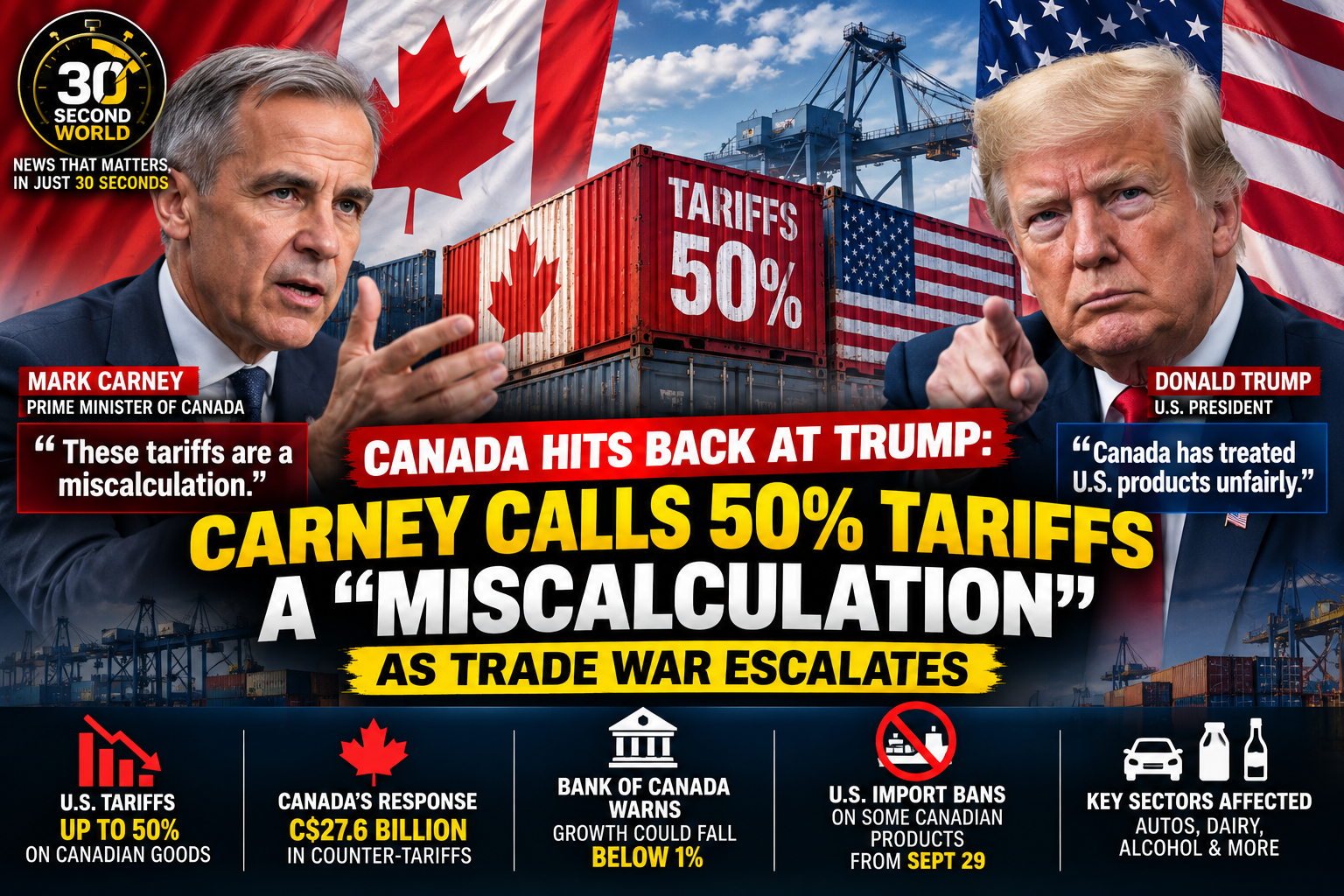
Canada’s trade confrontation with the United States has entered a more serious phase, with Prime Minister Mark Carney calling the latest U.S. tariffs a “miscalculation” and Ottawa imposing matching counter-tariffs on billions of dollars of American goods.
The dispute intensified after the United States imposed additional tariffs of up to 50% on selected Canadian goods, including products linked to dairy, alcoholic beverages and motor vehicles. The White House says the measures are designed to address what it describes as discriminatory Canadian trade practices.
Canada strongly disputes that framing and says the U.S. demands went too far.

Prime Minister Mark Carney said the new U.S. tariffs were designed to “hurt and divide” Canada and called them “a miscalculation.” He said Canada would respond by strengthening its own economy, diversifying trade and protecting Canadian workers and businesses.
What Triggered the Latest Canada-U.S. Tariff Fight?
The latest escalation followed weeks of negotiations between Ottawa and Washington.
On August 18, Carney said both sides had made “substantial progress” and that the U.S. had temporarily delayed implementation of its new 50% tariffs while talks continued.
That temporary pause did not last.
The White House later said Canada had failed to remove what Washington considered discriminatory measures related to U.S. dairy, alcohol and motor vehicles. The additional tariffs therefore took effect on August 22, 2026.
Canada, meanwhile, said the conditions proposed by Washington were not economically acceptable and would have harmed Canadian workers and strategic sectors.
Canada Responds With Dollar-for-Dollar Counter-Tariffs
Ottawa announced that it would match the U.S. measures “dollar for dollar, rate for rate.”
Canada’s Department of Finance says counter-tariffs covering C$27.6 billion worth of U.S. imports took effect on September 8. Rates of 15%, 25% and 50% apply to different products, depending on the U.S. tariff applied to the equivalent Canadian goods.
The Canadian countermeasures target sectors including:
- steel and aluminum
- dairy
- appliances
- agricultural equipment
- pulp and paper
- plastics
- electronics
Ottawa says the measures are designed to protect Canadian economic interests while matching the scale of the U.S. tariffs.
Why the U.S. Says It Imposed the Tariffs
The Trump administration argues that Canada has treated some American products unfairly.
The White House specifically cited Canadian policies involving:
- alcoholic beverages
- dairy products
- motor vehicles
For dairy, Washington says Canadian tariff-rate quota rules disadvantage U.S. cheese exporters.
For certain alcohol and automotive products, the U.S. government says Canadian policies impose unequal treatment on American commerce.
The administration has used Section 338 of the Tariff Act of 1930, which permits tariffs of up to 50% when the president determines that another country is discriminating against U.S. commerce.
Canada contests the U.S. interpretation and says accepting Washington’s latest terms would have undermined Canadian workers, businesses and national economic interests.
New U.S. Import Restrictions Are Coming
The dispute is not limited to tariffs.
The White House has also announced that certain Canadian goods currently subject to 50% tariffs will face import bans beginning September 29, 2026.
The restrictions affect some products linked to motor vehicles, dairy and alcoholic beverages.
This represents a further escalation because an import ban is more restrictive than a tariff.
A tariff makes imports more expensive.
A ban can prevent covered products from entering the market entirely.
Bank of Canada Warns About Economic Damage
The trade war is already affecting Canada’s economic outlook.
Bank of Canada Governor Tiff Macklem recently warned that the latest U.S. tariffs could push fourth-quarter Canadian economic growth below 1%, compared with an earlier forecast of around 1.5%.
The central bank has also highlighted the combination of:
- new U.S. tariffs
- Canadian countermeasures
- high energy prices
- weaker business confidence
- uncertainty around investment
as risks to the economy.
At its September policy meeting, the Bank of Canada kept its benchmark overnight rate at 2.25% and specifically noted that the breakdown of Canada-U.S. trade talks had created additional uncertainty.
Could Canadian Consumers Pay More?
Potentially.
Tariffs generally increase the cost of imported goods unless businesses absorb the extra cost themselves.
Canadian counter-tariffs could therefore raise prices on some U.S.-made products.
Similarly, American consumers and businesses may face higher prices for Canadian goods hit by U.S. duties.
The impact will vary by product, company and supply chain.
Businesses can respond by:
- switching suppliers
- sourcing goods domestically
- absorbing some tariff costs
- passing costs to customers
- reducing imports
That is why trade wars can affect inflation as well as economic growth.
Canadian Businesses Face More Uncertainty
For companies, uncertainty may be just as damaging as the tariffs themselves.
Businesses making long-term investment decisions need to know:
- what tariffs will apply
- how long they will last
- whether products will be banned
- whether supply chains must be changed
- whether new markets are needed
Macklem said that tariff uncertainty can discourage hiring and investment.
This is especially important for sectors that are deeply integrated across the Canada-U.S. border.
Auto Sector Could Be Hit Hard
Canada and the United States have highly integrated automotive industries.
Parts can cross the border several times before a finished vehicle is completed.
That makes automotive tariffs particularly disruptive.
The White House says some Canadian motor-vehicle products will face stronger restrictions from September 29, while Ottawa argues that the U.S. approach threatens workers and supply chains on both sides of the border.
Dairy Is Another Major Flashpoint
Dairy has long been one of the most sensitive Canada-U.S. trade issues.
Canada operates a supply-management system that controls domestic production and imports for products such as:
- milk
- cheese
- butter
- poultry
- eggs
The U.S. argues that Canadian quota allocation makes it harder for American dairy exporters to compete.
Canada says its policies are lawful and important for domestic producers.
The dispute over cheese and dairy access is one of the core issues behind the latest U.S. tariff measures.
Alcohol Trade Is Also Caught in the Dispute
Alcoholic beverages have become another major battleground.
Washington says Canadian rules discriminate against American alcoholic beverages and has moved from tariffs toward stronger restrictions on certain Canadian alcohol imports.
Canada has responded by placing tariffs on selected U.S. products as part of its broader retaliation package.
Carney Pushes Canada to Diversify Beyond the U.S.
One major theme of Carney’s response has been economic diversification.
Canada has historically relied heavily on the United States as its largest trading partner.
The current dispute is accelerating Ottawa’s push to deepen relationships with:
- Europe
- Asia
- ASEAN
- China
- other global markets
Canada is already negotiating trade agreements with the Philippines and ASEAN and is seeking broader energy and investment ties outside North America.
Carney has also emphasized expanding Canadian infrastructure, reducing internal trade barriers and attracting global investment.
Canada and Europe Are Moving Closer
The trade dispute with Washington is also coinciding with deeper Canada-Europe ties.
Carney recently met French President Emmanuel Macron and emphasized cooperation on:
- energy
- critical minerals
- trade
- climate
- technology
- strategic autonomy
The broader Canadian strategy appears aimed at reducing vulnerability to any single trading partner.
What Could Happen Next?
Several scenarios remain possible.
1. Negotiations Restart
Canada and the United States could eventually return to negotiations and reach a compromise.
2. Tariffs Remain in Place
If no agreement is reached, businesses may begin restructuring supply chains around the tariffs.
3. More Products Are Targeted
Either side could expand its tariff list.
4. Import Bans Deepen the Dispute
The September 29 U.S. restrictions could create a new round of Canadian retaliation.
5. Legal Challenges
Trade disputes can also move through domestic courts or international trade mechanisms depending on the legal basis of individual measures.
For now, neither government has announced a comprehensive settlement.
What Canadians Should Watch
The key dates and developments include:
September 29: new U.S. import restrictions on selected Canadian products are scheduled to take effect.
Bank of Canada decisions: policymakers will watch whether tariffs weaken growth or worsen inflation.
Retail prices: consumers may begin seeing changes on tariff-affected goods.
Business investment: companies may delay investment until there is greater certainty.
New trade partnerships: Ottawa is accelerating diversification toward Europe and Asia.
Canada-U.S. Trade War: Quick Facts
U.S. tariffs: Up to 50% on selected Canadian goods.
Canada’s response: Counter-tariffs on C$27.6 billion of U.S. goods.
Canadian counter-tariff rates: 15%, 25% and 50% depending on product.
Carney’s description: He called the latest U.S. tariffs a “miscalculation.”
Bank of Canada concern: Q4 growth could fall below 1% because of new U.S. tariffs.
Next escalation: Some U.S. import bans are scheduled for September 29.
The Bottom Line
The Canada-U.S. trade dispute has moved beyond a normal tariff disagreement.
Washington says its actions are designed to counter Canadian trade practices it considers discriminatory.
Ottawa rejects that interpretation and says the U.S. demands would harm Canadian workers and strategic industries.
Canada has answered the U.S. tariffs with C$27.6 billion in countermeasures, while Prime Minister Mark Carney has called the American strategy a “miscalculation.”
The economic consequences are now becoming more serious.
The Bank of Canada warns that new U.S. tariffs could push Canadian growth below 1% in the fourth quarter, while businesses face higher costs and greater uncertainty.
With additional U.S. import restrictions scheduled to begin September 29, the next few days could determine whether the dispute moves back toward negotiations — or escalates further.
30 SECOND WORLD — NEWS THAT MATTERS, IN JUST 30 SECONDS.
#Canada #UnitedStates #CanadaUSTradeWar #MarkCarney #DonaldTrump #TrumpTariffs #CanadaTariffs #TradeWar #CanadianEconomy #BankOfCanada #Tariffs #USCanada #BusinessNews #Economy #Trade #BreakingNews #CanadaNews #WorldNews #30SecondWorld