
Amazon Settlement 2026: Millions More Prime Customers Could Get Automatic Refunds of Up to $200
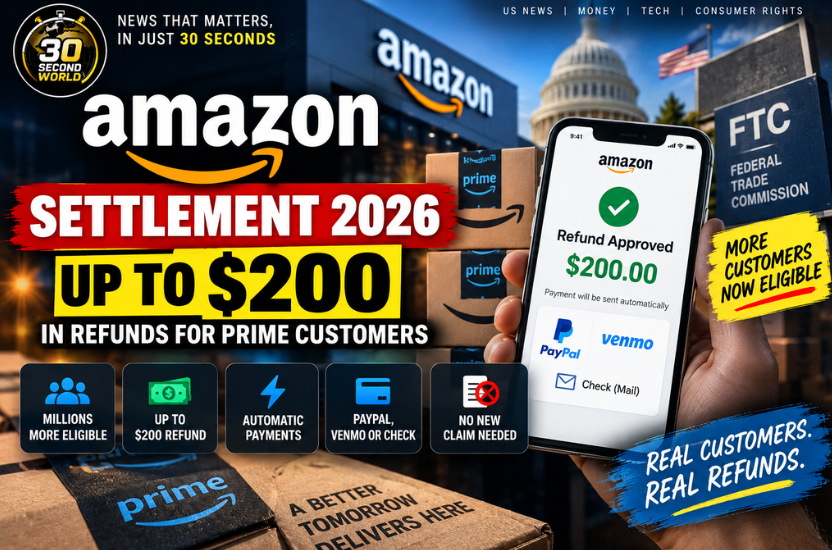
Millions of Amazon Prime customers in the United States could receive additional automatic refunds after the Federal Trade Commission expanded the terms of Amazon’s historic $2.5 billion Prime settlement.
The FTC announced on September 17, 2026 that Amazon will accelerate and broaden consumer payments connected to allegations that the company enrolled customers in Prime without clear consent and made cancellation unnecessarily difficult.
The biggest changes are significant:

- more Prime customers are now eligible
- the maximum refund can reach $200
- future payments will be automatic
- eligible consumers will not need to file new claims
- payments may arrive through PayPal, Venmo or mailed check
For U.S. consumers, this is now one of the biggest refund stories of the year.
What Is the Amazon Prime Settlement?
The case stems from a $2.5 billion settlement reached between Amazon and the FTC in 2025.
The FTC alleged that Amazon used confusing or deceptive design practices to enroll people in Prime subscriptions and then made it difficult for some customers to cancel.
Under the original deal, Amazon agreed to:
Pay a $1 billion civil penalty
and provide:
Up to $1.5 billion in consumer refunds.
That made it one of the largest FTC consumer-protection settlements in history.
By September 2026, Amazon had already issued more than:
$845 million
in refunds to eligible Prime customers.
Now, that refund program is getting even bigger.
What Changed in September 2026?
The FTC and Amazon jointly asked a federal court to modify the refund process.
The court approved the changes.
The revised order expands eligibility and removes more barriers for customers.
The three biggest changes are:
1. More Customers Qualify
Previously, refund eligibility focused heavily on people who used fewer than 10 Prime benefits during a one-year period.
Under the new order, consumers who used between:
11 and 20 Prime benefits
during a one-year period may also qualify for automatic payments.
This significantly expands the number of people who may receive money.
2. Refunds Can Now Reach $200
Originally, the maximum payment cap was:
$51
Under the revised settlement, eligible consumers may ultimately receive up to:
$200 total.
That is one of the main reasons the topic is suddenly trending across the U.S.
3. No New Claim Form Is Required
This may be the most important part.
Eligible consumers under the expanded program do not need to:
- submit a claim
- fill out a form
- respond to a notice
- or pay anyone
The FTC says future eligible payments will be distributed automatically.
When Will Amazon Send the New Refunds?
The new round of automatic payments is expected to begin:
October 1, 2026
Eligible customers may receive money through:
PayPal
Venmo
or a mailed check.
That means some customers may start seeing settlement payments within weeks.
The revised order also includes another possible round of payments in 2027.
Could Some Customers Get an Extra $149?
Yes.
Under the revised order, if the total amount of accepted consumer payments remains below the required settlement threshold by February 2027, some people who already received money may get an additional:
$149
That could bring their total refund to:
$200.
Those supplemental payments would begin by:
April 2027.
So even people who already received an earlier Amazon Prime refund should continue monitoring their payment accounts and mail.
Who Is Eligible for an Amazon Settlement Refund?
Eligibility depends on how a consumer interacted with Amazon Prime during the relevant period.
The settlement generally targets customers affected by allegedly deceptive Prime enrollment or cancellation practices.
The expanded order now includes additional consumers who used between 11 and 20 Prime benefits during a one-year period.
Not every Amazon customer automatically qualifies.
And not every Prime subscriber will receive the full $200.
The amount depends on settlement eligibility and the payment phase.
Do You Need to Apply?
For the newly expanded automatic-refund group:
No.
The FTC specifically says consumers should not need to complete new paperwork.
Amazon is responsible for administering the refund program.
That is important because trending settlement stories often attract scams.
WARNING: Amazon Settlement Scams Are Likely
Whenever a large refund program becomes public, scammers usually follow.
The FTC has issued a clear warning:
The FTC is not contacting consumers to ask for money in this case.
And:
Amazon will never ask you to pay money in order to receive a settlement refund.
If someone contacts you claiming:
“Pay a fee to unlock your Amazon refund”
or:
“Send us your banking password to verify eligibility”
that is a major warning sign.
The legitimate settlement does not require consumers to pay anyone.
How Will You Know if the Refund Is Real?
A legitimate payment may arrive through:
- PayPal
- Venmo
- mailed check
The FTC says Amazon is administering the refund process.
Consumers should avoid clicking suspicious links in random text messages or emails.
Instead, verify settlement information directly through official FTC or Amazon settlement channels.
Why Did the FTC Sue Amazon?
The original FTC case focused on Amazon Prime enrollment and cancellation.
Regulators alleged that Amazon used what are often called:
“dark patterns”
These are interface designs intended to push or manipulate users toward a decision they might not otherwise make.
The FTC said Amazon used design tactics that made Prime enrollment easier while making cancellation more difficult.
Amazon resolved the case through settlement rather than continuing the dispute through trial.
What Are Dark Patterns?
Dark patterns are online-design techniques that can influence consumer behavior.
Examples can include:
- pre-selected options
- confusing buttons
- hidden cancellation links
- repeated confirmation screens
- misleading wording
- making “yes” easier than “no”
Regulators around the world have become increasingly focused on these practices.
The Amazon case is significant because it shows that subscription design itself can become a major consumer-protection issue.
Why Prime Subscriptions Matter So Much
Amazon Prime is one of the most successful subscription programs in the world.
Prime can include benefits such as:
- free shipping
- Prime Video
- music
- special shopping offers
- photo storage
- additional digital services
Because subscriptions renew automatically, small design choices around signup and cancellation can affect millions of people.
That is why the FTC case became so large.
Why the Settlement Is Trending Now
There are three main reasons.
More people now qualify.
The revised order expands the refund pool.
The potential payment increased.
The maximum can now reach $200.
Payments are automatic.
People are searching to find out whether money could appear in their PayPal, Venmo or mailbox without filing another form.
Those three factors have created strong U.S. search interest around:
Amazon settlement
Amazon refund
Amazon Prime refund
and
FTC Amazon settlement.
How Much Has Amazon Paid So Far?
According to the FTC:
More than $845 million
had already been distributed by September 2026.
That makes this far more than a theoretical settlement.
Hundreds of millions of dollars have already reached consumers.
And more payments are still coming.
Amazon Settlement Timeline
Here is the simplified timeline:
September 2025
Amazon reaches a $2.5 billion FTC settlement.
November 2025
Amazon begins sending refunds to eligible Prime customers.
2026
More refund phases continue.
September 17, 2026
FTC announces expanded eligibility and higher payment limits.
October 1, 2026
New automatic refund payments begin for additional eligible consumers.
February 2027
Payment totals are reviewed.
By April 2027
Some consumers could receive additional automatic payments of up to $149, potentially bringing total compensation to $200.
Is This the Same as the Amazon Returns Settlement?
No.
This is important because Amazon has faced more than one settlement.
Earlier in 2026, Amazon separately agreed to pay $309 million in a case involving customers who said they returned products but were incorrectly denied refunds.
That is a different case.
The currently trending $2.5 billion settlement is about:
Amazon Prime enrollment and cancellation practices.
Do not confuse the two.
What Should Amazon Prime Customers Do?
For most people, the answer is simple.
1. Do not pay anyone.
No legitimate settlement agent should demand money to release your refund.
2. Check PayPal and Venmo.
Some automatic payments may arrive electronically.
3. Watch your mail.
Some refunds may arrive as checks.
4. Keep your Amazon contact information current.
Incorrect contact details can make payment processing more difficult.
5. Verify suspicious messages.
Do not trust random settlement links.
Could You Get $200 Automatically?
Potentially, yes.
But the $200 figure is a maximum total under the revised settlement.
It does not mean every Prime customer receives $200.
Some customers may receive smaller payments.
Some may receive an initial amount and later receive an additional payment.
Others may not qualify.
That distinction is important.
What if You Already Got $51?
You may still want to pay attention.
The revised order says some consumers who already received earlier refunds could become eligible for additional payments if settlement distribution thresholds are not reached.
That supplemental payment could be:
up to $149
bringing total compensation to:
$200.
What Does Amazon Say?
Amazon agreed to the settlement structure and the revised refund process.
The current update comes from a joint court motion involving both the FTC and Amazon, rather than a new lawsuit.
The company is responsible for administering the consumer payments.
Why This Case Matters Beyond Amazon
The Amazon Prime settlement could influence the broader subscription economy.
Companies selling:
- streaming subscriptions
- software
- memberships
- cloud storage
- digital services
are under increasing pressure to make cancellation as clear as enrollment.
Regulators are paying more attention to whether customers understand:
- what they are signing up for
- what they are paying
- when a subscription renews
- and how to cancel it
The Amazon case sends a strong signal to the entire industry.
The Bigger Subscription Problem
Automatic subscriptions are now everywhere.
Consumers pay monthly for:
Netflix
Spotify
cloud storage
fitness apps
VPNs
software
news sites
and dozens of other services.
Individually, a subscription might cost only $5 or $15.
Together, they can quietly consume hundreds of dollars every month.
That is why transparency around subscriptions matters.
30 SECOND WORLD Fact Check
Amazon has a $2.5 billion FTC settlement: ✅ Yes
Amazon has already paid more than $845 million to consumers: ✅ Yes
More customers are now eligible: ✅ Yes
Maximum total refund can reach $200: ✅ Yes
Everyone with Amazon Prime gets $200: ❌ No
Newly eligible consumers must pay a fee: ❌ No
FTC will call you to process the refund: ❌ No
Automatic payments begin October 1: ✅ Yes.
The Bottom Line
The Amazon Prime settlement has become much more significant for U.S. consumers.
Amazon’s original agreement already included up to $1.5 billion in customer refunds, and more than $845 million has been paid.
Now the FTC says:
millions more consumers may qualify,
future refunds will be automatic,
and:
total payments can reach up to $200.
The next major date is:
October 1, 2026.
That is when automatic payments for the newly expanded group are expected to begin.
For consumers, there is one final warning:
You do not need to pay anyone to receive a legitimate Amazon settlement refund.
If someone asks for money first, it is probably a scam.
30 SECOND WORLD — NEWS THAT MATTERS, IN JUST 30 SECONDS.
#Amazon #AmazonSettlement #AmazonPrime #AmazonRefund #FTC #AmazonPrimeRefund #ConsumerNews #MoneyNews #USNews #OnlineShopping #Settlement #Refund #BreakingNews #TrendingNews #30SecondWorld